How to Build a Social Media Content Calendar That Actually Works
Most content calendars fail for the same reason diets fail: they're built around what you think you should do, not around how your week actually works. You block out three posts a day across four platforms, feel good about the plan on Sunday night, and by Wednesday you're back to posting whatever comes to mind — if you post at all.
A calendar that survives contact with a real week is built differently. It starts with a goal, not a grid.
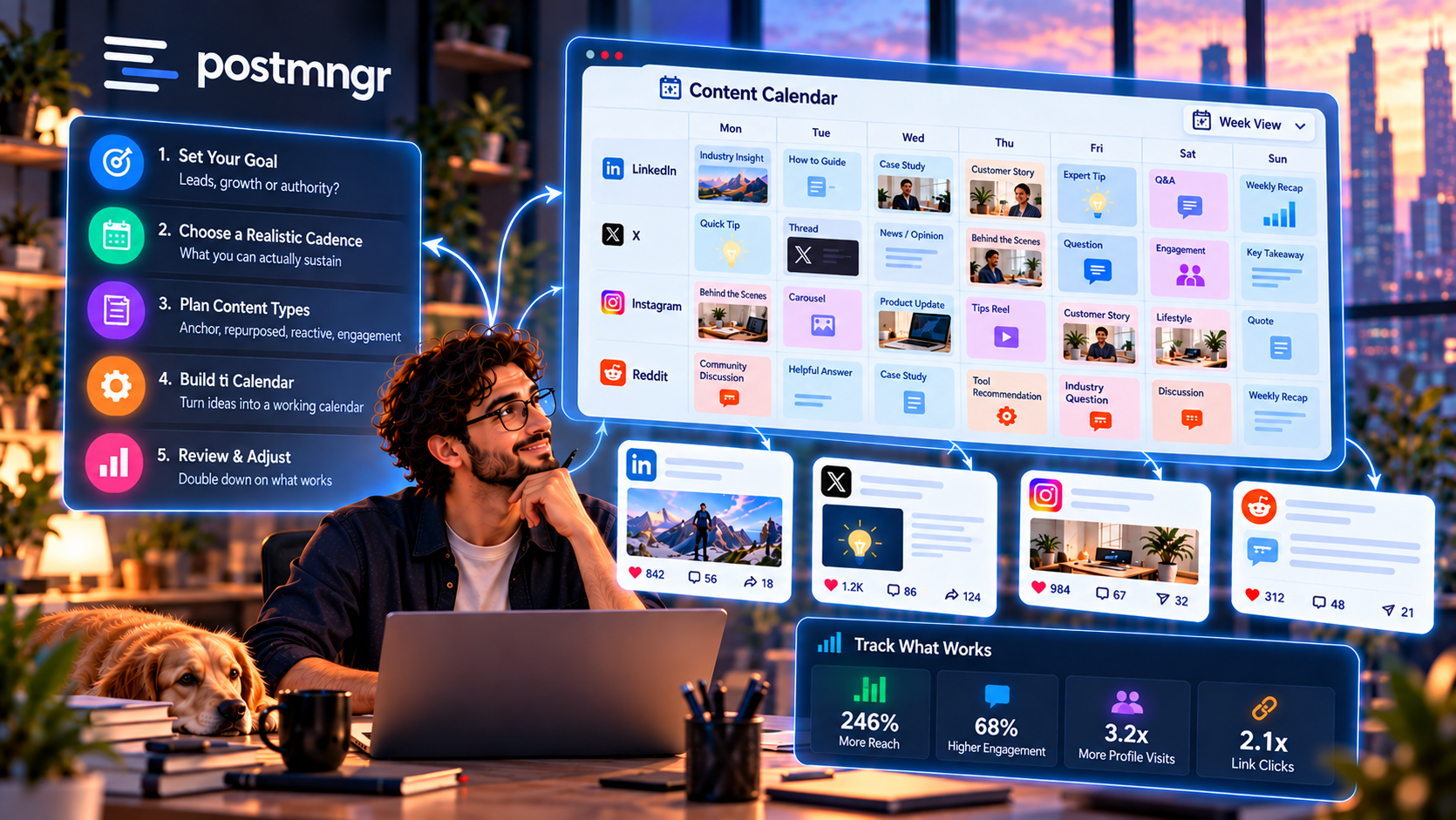
Start With One Goal, Not a Content Wishlist
Before you decide what to post, decide why you're posting. A calendar built to "stay active on social media" has no way to tell a good post from a wasted one. A calendar built around a specific goal — generating leads, growing an audience, building authority in your niche — gives every entry a reason to exist.
Pick one primary goal per platform. You can run different goals on different platforms (LinkedIn for authority, Instagram for brand awareness), but trying to do everything on every platform is how calendars turn into guesswork.
Questions to answer before you build anything
- What's the one outcome this platform needs to drive this quarter?
- Who is the specific person you're writing for — their role, their problem, their platform habits?
- What does "working" look like: replies, saves, link clicks, DMs, follower growth?
Choose a Cadence You Can Actually Sustain
The biggest calendar-killer isn't lack of ideas — it's setting a posting frequency that assumes a version of you with more time than you have. A realistic cadence, held consistently, outperforms an ambitious cadence that collapses after two weeks.
| Platform | Sustainable Starting Cadence | What Breaks It |
|---|---|---|
| 3–4x per week | Trying to post daily without a repeatable format | |
| X (Twitter) | 5–10x per week (mix of posts and replies) | Treating every post like a mini essay |
| 2–3x per week (feed) + regular Stories | Waiting for "perfect" visuals before posting | |
| 1–2x per week in relevant communities | Posting promotionally instead of contributing |
Set the cadence at the lower end of what feels sustainable. It's easier to add a post when you have momentum than to explain a three-week gap.
Build the Calendar Around Content Types, Not Just Dates
A calendar that only tracks dates and captions gives you no way to spot patterns. A calendar that also tracks content *type* lets you see, at a glance, whether you're leaning too hard on one format and starving the others.
A simple structure that works for most small teams:
- Anchor content — one substantial piece per week (a LinkedIn article, a longer thread, a carousel) that carries the core idea.
- Repurposed content — 3–5 posts derived from the anchor, reshaped for different platforms or angles.
- Reactive content — 1–2 posts responding to something timely: an industry conversation, a customer question, a comment thread worth expanding.
- Engagement content — posts and replies with no promotional intent at all, purely to stay visible in conversations.
Fill It In Backwards From Your Goal
Once the structure exists, fill it in by working backward from the goal you set for each platform, not forward from a blank page. If the LinkedIn goal is authority-building, every anchor post should answer a question your ideal customer is actually asking. If the Instagram goal is brand awareness, the mix should lean toward visual storytelling and behind-the-scenes content rather than hard sells.
This is also where most manual calendars start to strain — keeping a different goal, cadence, and content mix straight across four platforms, updated weekly, without letting one platform quietly take over the others. This is the specific problem PostMngr is built around: it sets a content plan per platform based on the single goal you choose, then drafts and schedules the week's posts against that plan so the calendar reflects a strategy instead of whatever's top of mind that day.
Review and Adjust on a Fixed Schedule
A calendar isn't a one-time document — it's a working system that needs a regular check-in. Pick a day every one or two weeks to look at what actually happened: which posts got read, replied to, or clicked, and which ones went nowhere.
- Drop content types that consistently underperform, even if they're easy to produce.
- Double down on formats that get replies or saves, not just impressions.
- Re-check your goal every quarter — a calendar built for lead generation in January might need to shift toward authority-building by summer.
Common Mistakes That Quietly Sink a Calendar
- Planning content, not conversations. A calendar full of polished announcements with no room for replies or comments will underperform a messier one that's actually part of the platform's conversation.
- One calendar, four platforms, one voice. Copy-pasting the same post everywhere reads as lazy on at least two of the four platforms.
- No owner. If no one person is responsible for keeping the calendar current, it decays within a month.
- Too much lead time. Planning six weeks out sounds efficient but leaves no room to respond to what's actually happening in your industry this week.
Frequently Asked Questions
How far in advance should a social media content calendar be planned?
One to two weeks is usually the sweet spot for small teams. It's far enough ahead to avoid daily scrambling, but close enough to stay responsive to real conversations and timely opportunities.
Should every platform follow the same calendar?
No. Each platform should have its own goal, cadence, and content mix, even if they live in the same overall calendar document. A single one-size-fits-all plan is one of the most common reasons calendars stop getting used.
What tools are actually necessary to run a content calendar?
At minimum, a shared document or board that tracks date, platform, content type, and status. Scheduling tools help with publishing but don't replace the strategic layer — deciding what to post and why still has to happen first.
How do I know if my content calendar is actually working?
Track outcomes tied to your stated goal, not vanity metrics. If the goal is lead generation, watch replies and DMs, not just likes. If the goal is audience growth, watch follower quality and engagement rate, not just follower count.
What's the biggest reason content calendars get abandoned?
Overcommitting to a posting frequency that doesn't match available time or content supply. A calendar built around three realistic weekly posts that actually get published beats one built around fifteen posts that mostly don't.